
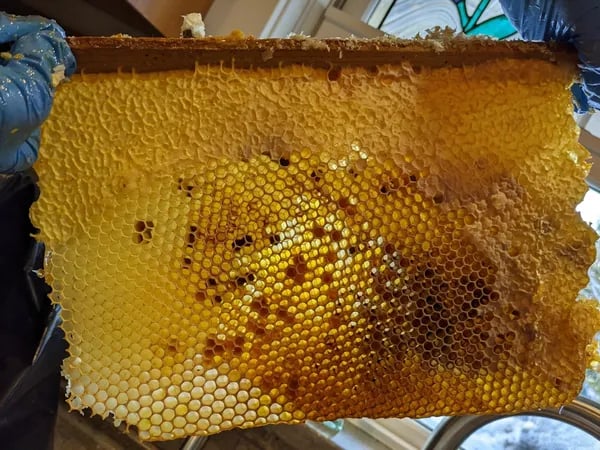


In the high mountain regions of Nepal, a rare variety of honey has drawn global attention for its unusual chemical properties and the ancient traditions surrounding its harvest. Known locally for generations, this honey is produced by bees that collect nectar from specific wild flowers, resulting in a product that can cause strong physical reactions when consumed inappropriately. For local communities, however, it is not a novelty but part of a carefully managed cultural practice tied to seasonal harvesting, knowledge passed down through families, and respect for the surrounding environment. What makes this honey especially significant is the intersection of tradition, ecology, and modern science, as researchers continue to study how natural compounds can affect the human body in both beneficial and harmful ways. This story explores how mad honey is harvested, why it has become so widely discussed, and why understanding its risks is just as important as appreciating its cultural and historical value. By focusing on facts rather than myths, this journey offers a balanced look at how nature can produce substances that are powerful, complex, and deserving of careful respect.
The Elusive Mad Honey and Its Origins
High in the remote Himalayan cliffs of Nepal, a rare and mysterious honey is harvested just two weeks each year. Known as Mad Honey, this extraordinary nectar is produced by Apis laboriosa, the world’s largest honey bee species. The process of Honey Hunting Nepal is not only a test of human endurance but also a living tradition that connects us to ancient times.
Apis laboriosa: The Giant Bees of the Himalayas
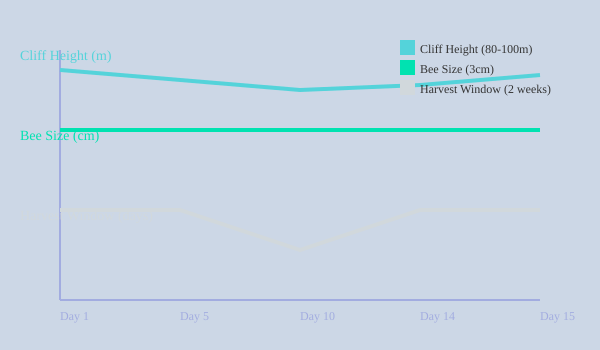
The Apis laboriosa bee is a true giant, measuring up to 3 centimeters—twice the size of an average honey bee. These bees thrive in the rugged Himalayan landscape, building their massive honeycombs on sheer cliffs that rise 80 to 100 meters above the ground. Their size and resilience are essential for surviving the harsh mountain climate and foraging for nectar in such remote areas.
Rhododendron Nectar and the Secret of Grayanotoxins
What makes Mad Honey so unique—and dangerous—are the grayanotoxins found in the nectar of local Rhododendron flowers. When Apis laboriosa bees collect this nectar, the resulting honey becomes infused with these potent compounds. In small doses, grayanotoxins can cause a mild sense of euphoria or altered perception. In larger amounts, however, they can lead to vivid hallucinations, slowed heart rate, paralysis, or even death. As one local story goes, “He was drunk, he slept for 3 days,” describing the honey’s powerful effects.
The Brief and Perilous Harvest
The mad honey harvest is limited to a narrow window—just two weeks each year—when the bees have filled their combs with the precious, toxin-rich honey. This short season makes the honey extremely rare and valuable. To reach the honeycombs, hunters must climb down dangerous cliffs using only handmade bamboo and rope ladders. The ladders often do not reach the bottom, so hunters must descend from the top, clinging to the rock face with their bare hands and feet. Shoes are not worn, as bare feet provide better grip on the slippery cliffs.
The climb is grueling and hazardous. Hunters endure countless stings from the giant bees, and any misstep can be fatal. As Nanda Lal Tamang, a veteran honey hunter from the Gurung tribe, says:
Mad honey hunting has been done since my forefathers.
We’ve to have a heart of stone to do this job.
Ancient Traditions: The Gurung Tribe and Their Heritage
The Gurung tribe, originally from Tibet, is the last community in Nepal still practicing this ancient form of honey hunting. Their methods have remained unchanged for thousands of years, as depicted in 7,500-year-old cave paintings found in the region. These paintings show figures climbing rope ladders and harvesting honey from cliffside hives, a tradition alive today in villages like Tanzi.
In the Gurung culture, honey hunting is more than a livelihood—it is a sacred ritual. Before each expedition, hunters perform protective ceremonies. Newcomers are blessed with water and given an amulet to ward off harm and evil spirits. The entire community, from elders to children, participates in the preparation and celebration of the harvest.
Mad Honey in Traditional Medicine
Throughout history, mad honey has been used in traditional medicine by local communities. In small, carefully measured doses, it is believed to treat various ailments and act as an aphrodisiac. However, the line between healing and harm is razor thin. Just one extra spoonful can cause severe poisoning or even be fatal. This delicate balance is respected by the Gurung, who have passed down their knowledge through generations.
Generational Knowledge and the Last Honey Hunters
Today, only one family in the remote village of Tanzi continues the practice of mad honey hunting. I met three generations of honey hunters—Bodhiman, his father, and his grandfather—whose hands bear the marks of a lifetime spent on the cliffs. Their skills and courage ensure that this ancient tradition survives, even as modern life encroaches on the mountains.
The Dangerous Art of Honey Hunting in Nepal
When I first witnessed the honey hunting process in Nepal, I realized immediately that this is not a job for the faint of heart. As Nanda Lal Tamang, a seasoned honey hunter, once told me,
“We’ve to have a heart of stone to do this job.”
Honey hunting Nepal is a tradition that demands courage, skill, and a willingness to face real danger. The pursuit of mad honey, known for its potent effects and risk of mad honey toxicity, involves scaling sheer cliffs, braving swarms of giant bees, and relying on handmade tools for survival.
Handmade Ladders and Perilous Heights
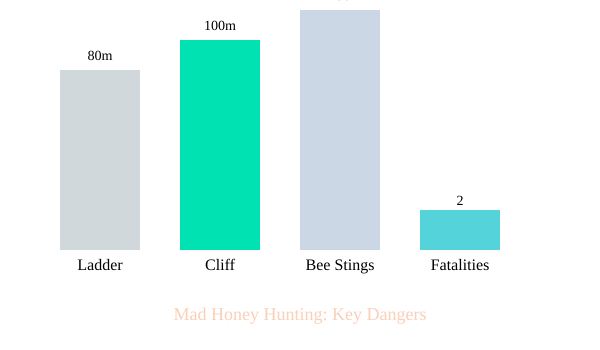
The journey begins with the construction of a ladder. Villagers work together, fitting wooden rungs into two long bamboo ropes, creating a ladder that stretches up to 80 meters. But the cliffs where the Apis laboriosa bees build their hives often rise even higher—sometimes up to 100 meters—so we have to start our descent from the very top. Every step in this process is manual, from tying the ladder securely to the trunk of a tree to ensuring the rope’s tip is properly fastened before anyone dares to climb down.
Barefoot Climbing: A Risky Necessity
One of the most striking aspects of honey hunting Nepal is that we climb barefoot. Shoes are left behind because bare feet give us a better grip on the slippery cliff face. It’s a risky choice, but it’s necessary for stability. As we make our way down, the danger is constant. A single misstep can be fatal—just last year, two hunters lost their lives during the harvest. There’s no safety net. If we fall, death is almost certain.
Facing the Giant Apis laboriosa Bees
The cliffs are home to Apis laboriosa, the world’s largest honeybee, measuring up to 3 centimeters in length. These bees are formidable defenders of their hives. Their stingers are long enough to pierce through clothing, and they attack in coordinated waves, raising their abdomens in a synchronized display that confuses and intimidates intruders. Even with beekeeper masks, we’re exposed—each hunt can result in up to 150 stings. The pain is intense, and swelling is common, but it’s a risk we accept.
Smoke: The Only Defense
Our primary defense against the aggressive bees is smoke. We create a giant incense bundle from freshly cut leaves and chalk, binding it tightly with rope. This smoldering bundle is lowered near the hives, sending thick smoke billowing over the bees. Without smoke, the bees would never leave. The smoke numbs them, first making them aggressive, then slowing their movements. But using fire so close to our ropes is dangerous. If the rope burns, there’s a real risk of falling or being caught in a fire mid-climb.
Minimal Gear, Maximum Danger
We wear beekeeper masks, but they offer limited protection against the giant bees. Most of us rely on our experience, balance, and teamwork. One hunter will climb down to the lowest point of the rope to help balance the ladder, while others provide support from above and below. We don’t wear shoes or gloves, as bare hands and feet are essential for gripping the cliff and the ladder. Every movement must be precise.
Real Risks: Falls, Stings, and Fatalities
Honey hunting Nepal is not just about collecting rare nectar; it’s about survival. The risks are real and ever-present. Fatal falls happen almost every year, and the pain from multiple stings can be overwhelming. As Nanda says,
“It’s a risky job and not everyone can do this.”
The danger is part of the tradition, and only those with skill, courage, and a deep respect for the process dare to take part.
Understanding Grayanotoxins and Mad Honey Effects
Mad honey, harvested from the steep cliffs of Nepal, is famous for its unique and sometimes dangerous effects. The secret behind these effects lies in a group of toxins called grayanotoxins, which are found in the nectar of certain Rhododendron flowers. As bees collect this nectar, they concentrate these toxins in their honey, creating what locals call “mad honey.”
How Grayanotoxins Work: The Science Behind Mad Honey
Grayanotoxins act on the sodium ion channels in our cells. Normally, these channels open and close to allow electrical signals to pass through nerves and muscles. When grayanotoxins bind to these channels, they force them to stay open. This causes prolonged depolarization of cell membranes, especially in nerves and muscles, including the heart. The result is a cascade of neurological and cardiovascular effects, which can be both fascinating and dangerous.
Neurological effects: Dizziness, confusion, hallucinations, and sometimes muscle paralysis.
Cardiovascular effects: Slowed heart rate (bradycardia), low blood pressure (hypotension), and in severe cases, atrioventricular block.
As one honey hunter, Nanda Lal Tamang, explained:
When I have the perfect dose, I see more clearly. I feel active mentally.
Mad Honey Effects: Dose Matters
The effects of mad honey are dose-dependent. A small amount, sometimes just a spoonful, can bring about a sense of mental clarity and mild euphoria. Some people even describe it as an aphrodisiac. In traditional medicine, mad honey is used in very small doses as an alternative therapy for hypertension, digestive problems, and sexual health. However, the line between a beneficial dose and a toxic one is thin.
Small doses: Mild stimulation, increased mental clarity, and aphrodisiac effects.
Moderate doses: Dizziness, nausea, vomiting, and a feeling of heaviness.
Large doses: Fainting, unconsciousness, paralysis, and even life-threatening heart rhythm problems.
One honey hunter recounted, “If you overeat, then it’s going to be very bad for you.” Another told the story of his father, who mixed mad honey with a raw egg and ended up sleeping on the toilet floor all night, unable to move properly the next morning.
Symptoms and Duration of Grayanotoxin Poisoning
Symptoms of grayanotoxin poisoning usually begin within a few minutes to a couple of hours after consuming mad honey. These can include:
Dizziness and confusion
Nausea and vomiting
Hallucinations
Muscle weakness or paralysis
Slowed heart rate and low blood pressure
Most symptoms last around 24 hours as the body metabolizes and clears the toxins. During this time, people may feel weak, disoriented, or even unable to move. In severe cases, medical attention is needed to manage heart rate and breathing.
Traditional and Clinical Perspectives: Mad Honey in Medicine
Despite its risks, mad honey has a long history in traditional medicine. In Nepal and Turkey, it’s used to treat high blood pressure, digestive issues, and as an alternative therapy for sexual health. Studies have shown that mad honey can lower blood glucose and lipid levels, likely due to its effects on the parasympathetic nervous system. However, traditional healers are careful with dosing, often recommending only a few drops or a small spoonful per year.
Globally, cases of mad honey poisoning have been reported in Nepal, Turkey, and Korea. Clinical reports confirm that overconsumption can lead to severe symptoms, including unconsciousness and respiratory distress. The price of mad honey reflects its rarity and potency—a 200g jar can cost up to $400, and it takes about 4 million bee visits to flowers to produce just one kilogram.
In the words of the honey hunters, “Everyone wants the mad honey. But when they see the reality of the job, they are astounded.” The allure of mad honey lies not just in its effects, but in the perilous journey from cliff to table—and the razor-thin margin between remedy and risk.

Personal Experience: Tasting Mad Honey and Its Sensory Effects
My journey with mad honey began with a mix of excitement and caution. I had heard stories of its potent effects—some people slept for days, others described feeling “drunk from head to toe.” The anticipation built as I watched the honey hunters prepare for the next day’s harvest, knowing that soon I would have my own encounter with this rare nectar. The group’s advice was clear: mad honey is not to be taken lightly. In these remote Nepalese hills, miles from the nearest health facility, even a small misstep could have serious consequences.
First Impressions: The Taste of Mad Honey
At breakfast, the honey was finally placed before me. Its color was deeper and more reddish than regular honey, hinting at its unique origin from rhododendron flowers. I dipped a spoon in and tasted it, expecting something sweet and floral. Instead, the flavor was a complex blend of bitterness and sweetness, followed by a distinct, spicy burn that spread across my tongue and the roof of my mouth. The sensation was immediate and unmistakable. As one of the local hunters said,
“It already started, as you said, it’s like eating something spicy.”
This tingling, almost electric feeling is a hallmark of mad honey and is caused by the presence of grayanotoxins, the compounds responsible for its hallucinogenic and toxic effects.
Onset of Mad Honey Effects: Tingling, Burning, and Beyond
The initial sensory effects of mad honey are rapid and dose-dependent. Within minutes, I noticed a tingling sensation in my mouth, which quickly intensified into a spicy, burning feeling. This is not the gentle warmth of ginger or chili, but a more persistent and slightly numbing burn. For some, this sensation can be pleasant, while for others, it may be overwhelming. The effects are unpredictable and vary from person to person, reflecting individual sensitivity to grayanotoxins.
After about 45 minutes, the systemic effects began to set in. I felt a light-headedness, almost as if I had consumed a strong alcoholic drink. My limbs tingled, and my heart rate seemed to slow. These are classic signs of mad honey intoxication. The locals warned me that even a single spoonful could cause fainting or vomiting, and two spoons might lead to unconsciousness or even temporary paralysis. As one experienced harvester put it,
“If I take a spoon of honey, you would faint, vomit, and be unconscious.”
Symptoms of Mad Honey Intoxication
Tingling and burning in the mouth and throat
Nausea and vomiting
Coughing and dizziness
Fainting or loss of consciousness (with higher doses)
Slow heart rate and low blood pressure
These symptoms can appear quickly and may last up to 24 hours. The unpredictability of hallucinogenic honey effects means that even experienced users approach mad honey with respect and caution. My own experience was relatively mild, likely because I ate food alongside the honey, which the locals say helps slow the absorption of toxins and moderates the onset of symptoms.
Individual Sensitivity and Dose Variance
One of the most fascinating aspects of mad honey is how differently it affects each person. Some people can tolerate a spoonful with only mild symptoms, while others may experience severe grayanotoxins toxicity from the same amount. This variability is due to differences in body weight, metabolism, and individual sensitivity to the toxins. The honey hunters emphasized the importance of starting with a very small amount and waiting to see how your body reacts before consuming more.
Respecting the Power of Mad Honey
My personal experience with mad honey left me with a deep respect for its potency and unpredictability. The unique bittersweet taste, the tingling burn, and the rapid onset of effects all serve as reminders that this is no ordinary honey. The excitement of tasting mad honey is always balanced by an awareness of its risks. In these mountains, the line between healing and harm is thin, and mad honey walks it with every drop.
Historical and Cultural Significance of Mad Honey
Mad honey, known locally as "red honey," is much more than a rare delicacy in Nepal. Its story stretches back thousands of years, weaving together threads of traditional medicine, ritual, and even warfare. For the Gurung people and other Himalayan communities, mad honey is a symbol of both danger and healing, a substance that demands respect and careful handling.
Ancient Uses: Medicine and Weapon
The earliest records of mad honey use date back over 2,000 years. In 67 BC, the Kingdom of Pontus used mad honey as a biological weapon against Roman soldiers. According to historical accounts, Pontic warriors left honeycombs filled with grayanotoxins—compounds responsible for honey toxicity—along the Roman army’s path. The unsuspecting soldiers consumed the honey, became disoriented and ill, and were easily defeated. As one researcher put it,
Mad honey is considered the earliest known biological weapon.
Beyond warfare, mad honey has long been valued in traditional medicine. Healers across Nepal and Turkey have used it as a remedy for gastrointestinal disorders, hypertension, diabetes, arthritis, and sexual dysfunction. Its aphrodisiac properties are especially prized, and small, carefully measured doses are believed to boost vitality and libido. However, the same grayanotoxins that give mad honey its potent effects also make it dangerous. The line between a therapeutic dose and a toxic one is razor-thin, and this paradox has fascinated—and sometimes frightened—people for centuries.
Mad Honey in Traditional Medicine
In the villages of Nepal, mad honey use is deeply rooted in local health practices. Elders and traditional healers administer it in small amounts to treat a range of ailments. The honey’s reputation as a natural aphrodisiac and its supposed benefits for blood pressure and joint pain make it highly sought after. However, everyone in the community knows the risks. Overconsumption can lead to symptoms like dizziness, nausea, and even loss of consciousness. This careful, measured use is a testament to the community’s respect for the honey’s power.
Rituals and Community Identity
For the Gurung people, mad honey hunting is not just a job—it is a sacred tradition. The harvest is surrounded by rituals meant to ensure the safety of the hunters and the success of the expedition. Before climbing the cliffs, hunters perform a chicken sacrifice. As I witnessed firsthand, “Now it’s time for the hunters to sacrifice the chicken. We pray, then cut it to prevent any accidents.” This ritual is believed to appease local spirits and protect the hunters from harm.
The journey to the cliffs is perilous. Hunters carry heavy ladders, sometimes needing two people to lift them, and cross treacherous terrain, including collapsed bridges and slippery paths. The entire process is a display of courage and unity. As we crossed a shaky bridge together, I was reminded, “We have to be like synchronized because we are shaking the bridge. Very dangerous.” These shared experiences strengthen community bonds and reinforce the Gurung identity.
The Paradox of Healer and Hazard
Mad honey’s dual nature as both medicine and poison is central to its cultural significance. The presence of grayanotoxins means that every harvest and every dose carries risk. This has led to a culture of caution and respect. Consumption is always carefully measured, and the honey is never taken lightly. The paradoxical reputation of mad honey—as both a healer and a hazard—continues to intrigue locals and outsiders alike.
Economic Realities: High Value, Low Reward
Despite its high market price—around $400 for just 200 grams—mad honey does not bring great wealth to the hunters who risk their lives to collect it. Most individual hunters earn less than $50 per harvest. As one local put it,
“Everyone wants the mad honey, but when they see the reality of the job, they are astounded.”
The economic benefits are limited, even as demand grows among collectors and those seeking its aphrodisiac properties.
Mad honey remains a powerful symbol in Nepalese culture. Its history as a medicine, a weapon, and a sacred substance continues to shape the lives and identities of those who harvest and use it. The traditions and rituals surrounding mad honey endure, a testament to the enduring allure—and danger—of this rare nectar.
Modern Perspectives and Safety Considerations
As I reflect on the mysteries and allure of Nepal’s mad honey, it’s clear that modern perspectives are shaped as much by caution as by curiosity. The honey’s potent effects are legendary, but so are the risks. Today, the conversation around mad honey toxicity and grayanotoxin poisoning is more urgent than ever, especially as interest grows in its use as an alternative therapy. The unpredictable nature of its toxin content means that even experienced locals treat it with deep respect—and for good reason.
Watching the harvest unfold, I was struck not just by the acrobatic skill of the hunters—“He’s like an acrobat there”—but by the ever-present danger. The cliffs are unforgiving, and the bees are relentless. “If there’s anything more dangerous than mad honey itself, surely the way of harvesting it,” one observer noted. The risk isn’t just in the climb; it’s in the honey itself. If a hunter were to fall from the 100-meter cliffs, survival would be impossible. But even after the honey is safely collected, the peril remains.
Mad honey contains grayanotoxins, compounds that can cause a range of clinical effects. Scientific studies have shown that these toxins impact blood pressure, heart rate, and metabolic parameters. The symptoms of mad honey poisoning—nausea, vomiting, dizziness, blurred vision, and even paralysis—can set in quickly. In severe cases, people have lost consciousness or experienced dangerous drops in blood pressure. As one local put it,
If I take two spoons, you don’t know anything. You would lay down like paralyzed.
The effects usually resolve within 24 hours, but the experience can be harrowing and, in rare cases, fatal.
Globally, clinical reports of mad honey toxicity have surfaced from places as far as Turkey and Nepal to remote corners of Europe and Asia. These cases highlight the importance of dosage control and medical awareness. The toxin content in mad honey is highly variable, depending on the season, the flowers the bees visit, and the specific region. This unpredictability makes unsupervised use especially hazardous, particularly for those seeking its effects as an alternative therapy. There is ongoing debate in the medical community about whether the potential benefits outweigh the risks, given the lack of standardization and the possibility of grayanotoxin poisoning.
In the villages of Nepal, tradition and caution go hand in hand. Hunters and locals restrict their consumption to just a few spoons a year. This practice is not only a cultural norm but a safety measure, passed down through generations to minimize the risk of poisoning. “It’s a risky job and not everyone can do this,” one hunter remarked, a reminder that both the harvest and the honey itself demand respect. Local knowledge dictates that mad honey is best consumed in small, carefully measured doses, and never alone. Consuming it in isolation, especially in remote areas, can be dangerous due to the risk of sudden paralysis or unconsciousness, which could leave a person unable to seek help.
Despite these longstanding traditions, public health messaging about mad honey remains limited outside native regions like Nepal and Turkey. Many international consumers are unaware of the potential dangers, and there are few educational campaigns to warn about the risks. As mad honey gains attention for its supposed medicinal properties, it is crucial to spread awareness about safe consumption practices and the signs of toxicity. Medical professionals outside endemic areas may not recognize the symptoms of mad honey poisoning, which can delay treatment and increase the risk of complications.
In conclusion, the story of mad honey is one of both wonder and warning. Its potent effects and mysterious origins continue to fascinate, but the dangers are real and ever-present. Whether considered as an alternative therapy or a rare delicacy, mad honey demands respect for its unpredictable power. As interest spreads beyond the Himalayan cliffs, so too must our understanding of its risks. Only through education, caution, and respect for local wisdom can we safely unlock the secrets of Nepal’s rare nectar.
