


Located just outside Kuala Lumpur, the Batu Caves complex is one of Malaysia’s most significant cultural and religious landmarks. Centered around the Murugan Temple, the site is set within ancient limestone caves formed hundreds of millions of years ago and has long served as a place of worship and pilgrimage. Today, the caves are also a major destination for visitors interested in history, architecture, and living religious traditions. The iconic staircase leading to the main Temple Cave, with its 272 steps, has become a defining visual symbol of the site, reflecting both its physical and spiritual ascent. This story explores the origins of Batu Caves, the cultural meaning behind its rituals, and the experience of visiting a place where geology, faith, and daily life intersect. By focusing on historical context and respectful observation, it offers a thoughtful introduction for international readers seeking to understand the significance of this remarkable destination beyond its visual appeal.
First impressions: Arrival & the entry gate
Arriving at Batu Caves from Kuala Lumpur
I came to Batu Caves from Kuala Lumpur, and the easiest budget choice was the metro. The ride is usually around 2–3 ringgit, but I still had a 10–15 minute walk from my area to the station, which is common for visitors. On another visit, I used Grab instead—more expensive, but it saved time and dropped me right near the entrance.
The entry gate and the first “wow” moment
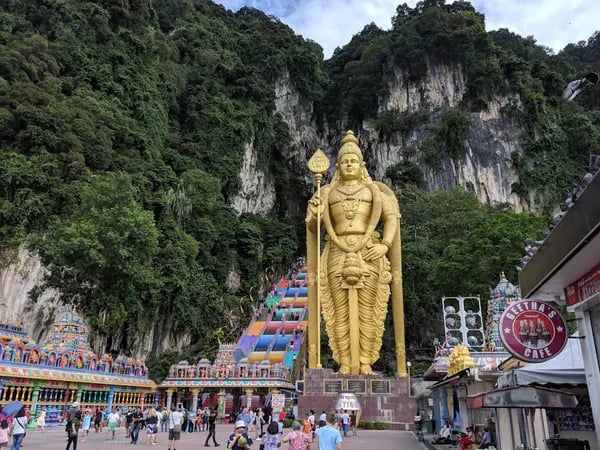
The first thing that hit me was the ornate entry gate. It looks carefully designed and almost theatrical, like it’s framing what you came to see. And right behind it is something even bigger: the ancient limestone hill where the caves formed—locals often mention it’s around 400 million years old, which feels hard to believe until you’re standing there.
Murugan Statue: the anchor of the entrance
From the gate, I could already see the Murugan Statue—a massive, gold-painted figure that dominates the plaza. It’s said to be about 140 feet (around 42–43 m) tall, and it works as both a photo magnet and a devotion point. People pause here to look up, pose, pray, and take a breath before moving on toward the Murugan Temple inside the Temple Cave.
The mood before the 272 steps
The visitor experience starts well before the staircase. The base area is busy and loud in a very human way—pigeons everywhere, and sometimes monkeys watching from the edges. Vendors line the approach with bright, practical offerings that remind you this is a living shrine, not just a landmark.
Flower garlands and small puja plates
Devotional items and trinkets
Cold drinks for the heat
Climbing the 272 colourful steps — sensory ascent
272 steps that feel like a journey
From the base of Batu Caves, the Colorful Staircase looks almost playful, but the number is real: 272 steps before I can reach the Temple Cave. I start climbing and quickly understand why this ascent is iconic. It is physical, yes, but it is also visual—each step pulls my eyes to a new band of colour, and that small distraction makes the effort feel lighter.
People, pace, and a relatable pause
The stairs are busy in both directions. Families climb in small groups, devotees move with quiet focus, and solo travelers stop often for photos. I try to keep a steady rhythm. Surabhi, though, decides to stay below—halfway up, the height feels like too much for her today. It’s a simple moment, but it makes the climb feel human: everyone takes Batu Caves at their own pace.
Views between breaths
After the first stretch, I turn around and the scene opens up. Between the railings and the crowd, I catch glimpses of Kuala Lumpur in the distance and thick greenery closer to the limestone hill. On the sides, I notice smaller shrines and statues tucked near trees, and a large animal sculpture that stands out as I climb past it.
Practical relief near the top
As the air gets warmer and my throat dries, I’m glad to see stalls near the upper plaza. Water and soft drinks are easy to find, and tired climbers gather there for a quick reset before stepping into the cave entrance.
Why the colours matter
The staircase wasn’t always this bright. The vivid repaint in 2018 changed how people experience the climb—turning it into a photo magnet and, for me, something close to a ritual: step, colour, breath, repeat.
The giant Murugan statue: numbers, materials and myth
Before I even step into Batu Caves, the Murugan Statue takes over the whole view. The transcript notes the caves formed around 40 crore years ago, yet this towering figure is a much newer symbol. As a post-19th-century addition, it helped shape Batu Caves’ modern identity—part sacred space, part landmark that almost every visitor photographs.
Numbers that define the Murugan Statue
Standing at about 140 feet, the golden statue of Lord Murugan dominates the forecourt outside the entrance. It sits right before the climb, like a guardian marking the shift from city noise to temple focus.
Height: ~140 feet
Paint used: ~300 litres of gold-mixed paint
Cost mentioned: ~24 million rupees
Year linked: 1892
Materials, spending, and imported gilding
The shine is not just sunlight. The transcript mentions 300 litres of gold-mixed paint imported from Thailand to gild the surface. Under that glow, the build is practical: concrete and steel, with a construction figure of about 24 million rupees. Those details made the scale feel real to me—this wasn’t a small temple ornament, but a major project meant to be seen from far away.
Myth and meaning: Lord Murugan at Batu Caves
Inside the caves is the temple of Lord Murugan, a key pilgrimage site for Tamil Hindus. Murugan is also known as Kartikeya, and in Tamil usage as Velai Uththar, a warrior deity linked with courage and protection. Historically, K Thamboosamy Pillai is credited with promoting the site and commissioning efforts tied to the shrine’s growth in the late 19th century.
During Thaipusam, the statue becomes both a visual meeting point and a devotional focus, where worship and tourism stand side by side.
Temple Cave interior: rock formations, shrines and atmosphere
Walking into Temple Cave at Batu Caves felt like stepping into another world. The space opens up fast—huge, dark, and cathedral-like—yet the air is cool. Water seeps from the ceiling in slow drips, and that constant moisture makes the stone shine. Knowing these Limestone Caves are said to be around 400 million years old made every step feel small and quiet.
Ancient limestone, living Hindu worship
What surprised me most is how the cave is both natural and carefully maintained as a Hindu Temple. You can see layered rock walls, hanging formations like stalactites, and rounded, stalagmite-like bumps near the floor. Then, right beside them, there are rock-sculpted platforms and sections painted in gold, turning rough stone into a devotional space.
Shrines inside the Cathedral Cave
Inside, I passed several small shrines before reaching the main sanctum, the Sri Velai Uththar Temple. Devotees were doing puja with flowers and naivedya plates, and the smell of incense mixed with damp limestone.
In Temple Cave, nature sets the stage, and faith fills it with meaning.
Etiquette and small moments
Remove shoes in sacred areas before approaching the shrines.
No smoking is enforced inside temple zones.
Keep your voice low—sound echoes strongly in the cave.
Monkeys and pigeons were active around the offerings. I even watched a monkey steal a banana and disappear up a ledge. With filtered light from above, echoing chants, and steady water drips, the atmosphere felt timeless—serene, but always alive.
History and origins: from local shelters to global fame
Batu Caves history before the crowds
When I first headed out from my hotel to see these 40-crore-year-old limestone caves near Kuala Lumpur, I kept thinking about how long people have known this place. Long before any temple steps or tour buses, local Orang Asli (indigenous communities) used parts of the caves as shelter and resting space. Local oral stories also connect the hill to earlier settlements, which helps explain why the caves never felt “new”—only newly noticed.
Origin History: miners, limestone, and early outside attention
In the 1860s, Chinese miners began digging around the hill after finding valuable limestone and fertilizer-rich deposits. This practical use changed the caves from quiet shelter to a working site, and it also brought more outsiders into the area. The name “Batu” is often linked to a nearby river or place name, which fits with how locals described the landscape long before it became a landmark.
Global awareness grew in 1878 when William Hornaday, an American naturalist, wrote about the caves. That single mention helped push Batu Caves from a local place into travel writing and wider curiosity.
K Thamboosamy Pillai and the Murugan temple turning point
The biggest shift in Origin History came in 1891, when K Thamboosamy Pillai helped establish a Murugan temple presence here. In 1892, he organized the first Thaipusam celebration at Batu Caves, setting the pattern for the pilgrimage site I see today.
1860s: mining and fertilizer deposits draw attention
1878: Hornaday publicises the caves
1891–1892: temple foundation and first Thaipusam
Over time, Batu Caves transitioned from indigenous shelter to a formal Hindu pilgrimage complex in Gombak, Selangor, about 13 km north of Kuala Lumpur.

Religious life: festivals, pilgrimages and devotional practice
Religious Significance in the wider Hindu Pilgrimage map
When I left my hotel and headed toward Batu Caves to see the 40-crore-year-old limestone caves near Kuala Lumpur, I was also stepping into a living Hindu Pilgrimage site. Batu Caves is one of the major Murugan temples outside India, and devotees link it to a wider network of Murugan tirthas: six of Kartikeya’s ten are in India, and four are in Malaysia, including this shrine to Lord Murugan.
Thaipusam Festival: the spiritual peak of the year
The Thaipusam Festival anchors Batu Caves’ calendar. First celebrated here in 1892, it now draws multinational participation—Tamil Hindu families, pilgrims from across Asia, and global tourists who come to witness the scale. On Thaipusam days, the stairs and temple paths become a river of people, with long queues, music, and striking processions. If you want a calmer visit, it helps to plan outside major festival dates because access patterns change fast with the crowds.
Daily worship: offerings, shrines, and the vel
On regular days, the mood shifts. I saw quiet devotion: shoes left outside, hands folded, and simple offerings carried carefully.
Fresh flowers and garlands
Naivedya plates with fruit and sweets
Prayers and small rituals at the sanctum
Beyond the main Murugan focus, the complex includes smaller shrines connected to his worship, including shrines to Lakshmi and figures like Devayani. Throughout the site, the vel (Murugan’s spear) appears in iconography and ritual objects—an instant marker of identity and protection.
I felt two opposite moods coexisting in the same space: festival energy in the stories people told, and steady, everyday faith in the way they prayed.
Geology and the Dark Cave: ancient limestone and living ecosystems
As I climbed the colorful steps toward the shrine, my mind kept circling one deep-time fact: these Limestone Caves began forming around 400 Million Years ago. I repeated it like a mantra, because it made the whole place feel bigger than a normal tour—older than anything I can truly picture.
400 Million Years inside a living temple cave
The main Cathedral-like Temple Cave is huge, cool, and echoing. Even though it is a religious space, I noticed how the rock itself becomes part of the experience. There are many smaller caverns and niches tucked into the walls, and several are used for shrines. It felt like devotion had found its way into every natural corner.
Water, time, and Natural Formations
What shaped all this was not a sudden event, but slow work. Water seeps through cracks, carries minerals, and leaves them behind drop by drop. Over long periods, this creates Natural Formations that look like stalactites and stalagmites. I could hear faint dripping in places, and it helped explain why the cave air stays so calm and cool.
Dark Cave: conservation beside worship
The Dark Cave is a separate tour area, and it adds a conservation-focused side to Batu Caves. With a guide, I learned how delicate the formations are and why access can be limited. The cave is also home to wildlife adapted to low light, including bats and small invertebrates.
Wildlife: bats, cave insects, and other specialized fauna
Focus: protection of fragile rock and habitats
Value: scientific interest alongside spiritual meaning
Standing between shrines and stone, I kept wondering how devotion and conservation can share the same space—and how carefully this site must balance both.
Practical tips: planning, etiquette and what to bring
Transport from Kuala Lumpur
For this Tourist Attraction, I usually take the metro because it’s the cheapest way to reach Batu Caves from Kuala Lumpur. Typical fares are around 2–3 ringgit, and from some hotels I plan an extra 10–15 minutes to walk to the station. If I’m short on time or traveling with family, I book a Grab for door-to-door convenience.
Timing: beat the heat and crowds
The colorful steps up to the Temple Cave look amazing in the morning light, and arriving early helps me avoid the midday heat on the climb. On festival days (especially Thaipusam), I plan far ahead because crowds can be intense and access routes may change.
Dress code and temple etiquette
I dress modestly (covered shoulders and knees) and follow the rules inside shrine areas. Shoe removal is expected, and no-smoking zones are enforced. I keep my voice low and avoid blocking worshippers on the stairs or at entrances.
Remove shoes in temple areas, respect no-smoking rules, and behave quietly and respectfully.
What I bring (and why)
Water + a small towel: I hydrate before and after the climb; stalls at the top sell drinks, but I don’t rely on them.
Cash: ATMs aren’t abundant inside the complex, and I like having small notes for flowers, naivedya, puja plates, and small souvenirs.
Simple bag with zippers: easier to keep items secure on the steps.
Safety and accessibility
I watch for monkeys near offerings and never leave food unattended—they can grab it fast. The stairs are steep and numerous, so if mobility is an issue, I plan to spend more time at the lower shrines and viewpoints instead of pushing to the top.
Souvenirs, side-stories and small human moments
Before I even started climbing, the forecourt of Batu Caves pulled me in like a living market around a sacred place. This Tourist Attraction is also a working space for Hindu Worship, and the stalls sit right in the middle of that daily rhythm.
Souvenirs and offerings at the stalls
Along the entrance and near the base of the colourful stairs, I saw rows of sellers offering simple, useful items. Many were clearly meant for devotion first, and keepsakes second—yet they work well as both.
Flower garlands for devotees heading to the shrine
Naivedya (puja plates) arranged with bananas, coconuts, and incense
Small Murugan figurines and other Souvenirs that are easy to carry
What stayed with me was the quiet choreography: vendors lining up plates neatly, adjusting flowers, and explaining what each item is for to first-time visitors. Buying these offerings felt like a small way to support local families while respecting the temple’s flow.
Wildlife and tiny surprises
Pigeons gathered in soft waves across the plaza, and feeding them felt oddly calming, like a pause button in the crowd. Then, a monkey turned the scene into comedy—he darted in and gleefully grabbed a banana straight from an offering plate before anyone could react. It was funny, but also a reminder that Batu Caves is lively, not staged.
“Tourists love the colours,” a vendor told me, pointing at the freshly repainted stairs.
That short chat, a vendor’s smile, and a child laughing halfway up the steps made the place feel human, not just monumental.
Final reflections: why Batu Caves stayed with me
Batu Caves as deep time, living faith, and spectacle
What stayed with me most about Batu Caves was the contrast: a limestone world said to be 400 million years old, yet filled with fresh paint, camera clicks, and the steady rhythm of worship. It is a Pilgrimage Site, but it is also a loud, busy landmark of Malaysian Heritage that draws millions of visitors each year. Somehow, those opposites don’t cancel each other out—they sit side by side.
272 steps that felt like more than a checklist
The 272 steps and the colourful staircase changed the mood of the climb. Instead of feeling like “one more tourist task,” it felt closer to a small act of devotion—especially as I watched people carrying offerings and moving with purpose. My friend Surabhi stopped partway, and that made the moment more human: Batu Caves lets you choose your own pace, and your experience really depends on heat, crowds, and how long you want to linger.
Quiet corners inside the Temple Cave
Inside the Temple Cave, I found pockets of calm. Water dripped from above, the air felt cooler, and prayers sounded softer, almost swallowed by stone. In those moments, the place felt intimate and ancient, even with vendors nearby and people flowing through.
A small ecosystem of people, trade, and wildlife
Devotees, shopkeepers, tourists, and monkeys all shared the same space. That mix made the site feel like its own ecosystem—conservation and devotion coexisting in real time.
Practical: dress modestly, expect crowds, carry water, and respect temple etiquette.
Emotional: arrive curious, not rushed—you may be surprised by what moves you.
If I go back, I would book a guided Dark Cave ecological tour to understand the biodiversity I barely scratched, and to see another layer of this living heritage.
Wild cards: a quote and a playful hypothetical
Batu Caves stands as both a natural wonder and a spiritual beacon
I carried that line in my head as I faced the Colorful Staircase at Batu Caves. It is not a documentary quote, more like a clean summary of what I kept reading in guidebooks and what I felt on site. In the end, the stairs are just the start: 272 steps that lead you from street noise into a place many people treat as a true Pilgrimage Site.
If the colours vanished, would we still climb?
Here’s my playful hypothetical. What if the colourful staircase disappeared tomorrow—no bright paint, no photo magnet, just plain stone steps? I suspect pilgrims would still climb. Devotion outweighs paint. The visual features are powerful, yes, but they are not the only reason people come. Thinking this way helped me shift from “tour mode” to “pilgrim mode,” even if I was only visiting for a day.
A cave like a cathedral
Inside, the cave felt like a cathedral carved in stone by time, then furnished by people. The scale is natural, but the meaning is human: prayers, offerings, and quiet focus under rock that has watched centuries pass.
A one-minute practice at step 136
Next time, try a small reflective practice: at step 136 (half of 272), stop for one full minute with no photography. Just breathe and notice what changes—your legs, your thoughts, the heat, the rhythm of other climbers. Small pauses like this can deepen a visit and make it less souvenir-driven.
One last tangent: if you could soundtrack the climb, what song would you pick? I chose a slow hymn to match the echoing drips. These little wild cards are how I want to remember Batu Caves—not as a checklist, but as a living climb.
